EDTECH · MOBILE · CONSUMER
My Role
Product Designer
End-to-end, sole designer
Scope
Research · UX · Gamification
Mobile design
Brief Vs. Reality
3 months · Discovery to delivery
Client
Avanti Learning Centres · IIT-JEE Coaching · Mobile App

Core screens
The Problem
Three reasons students stop showing up, even when they want to succeed.

User Journey Map (Left) | User Personas (Right)
WHAT I DID
Explored > Test > Deliver

Made gamification inseparable from the learning, not layered on top.
Credits are earned through demonstrated understanding (test performance), not passive activity (time spent). Topics unlock after passing a test, not after watching a video. The reward is tied directly to comprehension, so students can't skip ahead and the system can't be gamed by leaving a lecture playing.
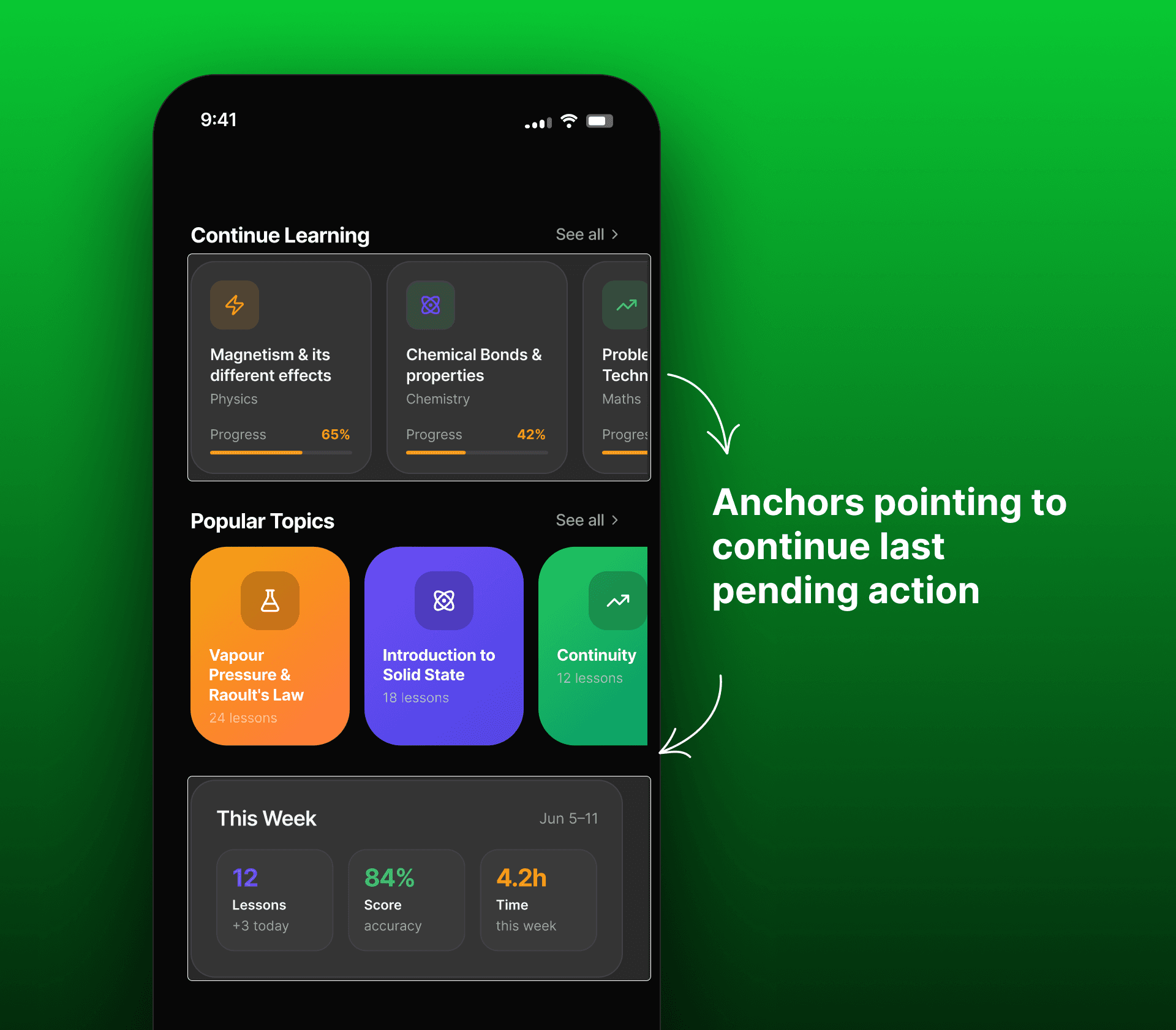
Built the Home screen as a daily anchor, not a dashboard.
Every element on the home screen either surfaces a pending task or rewards a completed one. Continue Learning is the most prominent feature, picking up exactly where the student left off with no navigation required. Credits are always visible. Subject coverage is at a glance. The goal: reduce the activation cost of starting a session to near zero.

Designed a Weekly Planner with smart calculations, turning intentions into diaried commitments.
The planner automatically calculates how much content needs to be covered per day based on exam date and current progress. Students set specific daily goals within the planne, those goals surface on the home screen, closing the loop between planning and doing. Contextual notifications (missed slot, streak at risk, session reminder) are triggered by planner state, not scheduled blasts.
The Result
Study. Test. Earn. Unlock.
Students surveyed who explicitly wanted a reward system, directly validated this approach
Students who wanted planner integration, the Weekly Planner was research-driven, not assumed
Core screens, each solving exactly one of the three engagement failure modes

Credits, Home, & Continue learning